
Douglas Rushkoff Interview
"We have to co-metabolize, in the present moment, together."

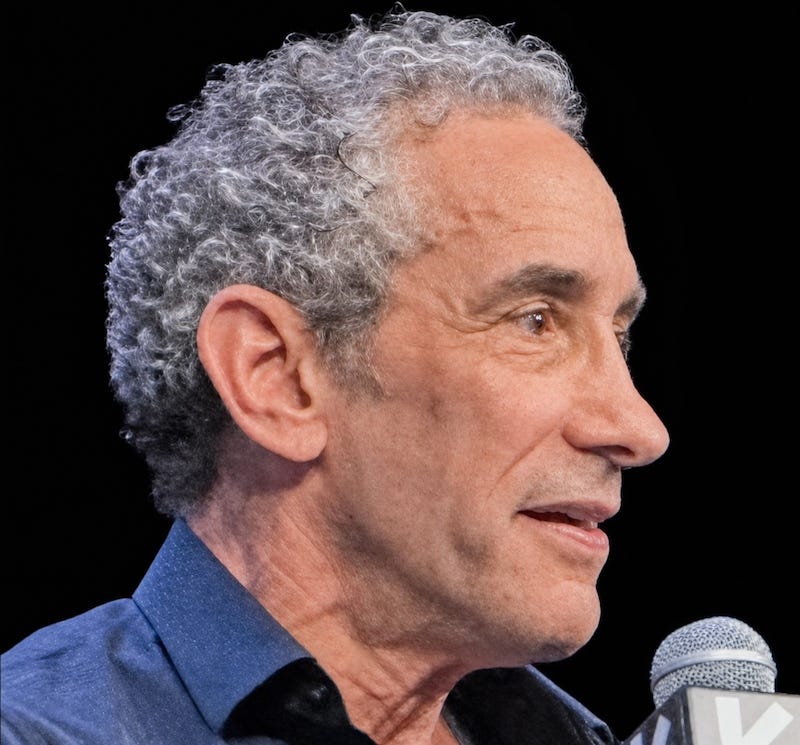
In the following interview, Douglas Rushkoff and I discuss how AI works best as a targeted tool that supports human thought and eliminates drudgery, and not as an “everything machine” that replaces thinking. He warns that today’s AI race encourages cognitive dependence, corporate manipulation, environmental exploitation, and endless output under industrial capitalism. His alternative is distinctly human: retain authority over our tools, favor limited and specialized systems, and rebuild compassion, mutual aid, and community through embodied, face-to-face relationships.
Acros defined:
LLM = Large Language Model, an AI system trained on massive inputs of text to learn and practice natural (human) language processing.
SLM = Small Language Model - similar to an LLM but much smaller, more compact, more targeted.
“… the only means of fighting a plague is — common decency.” ~ Albert Camus
Here’s the interview:
Jon: We’re all struggling to understand what current and evolving AI systems will mean for the humans that built them. There are technical and business conversations about the subject, but I think you’re having some of the most interesting conversations: not about AI business, AI bubbles, or AI technology, but about AI impact on what it means to be human. At this point, after having many conversations about this and advocating over the last decade for “Team Human,” what’s your current thinking about AI? What is the promise of AI, and what do you fear most about it?
Doug: I go back and forth on AI, so it really does depend on the day. I did a pre-interview for CNN on a day I was afraid of the AI future, but by the time I did the interview the next day, I felt like the whole thing was overblown and I couldn’t get worked up about it at all.
Right now, I’m kinda down on AI, having struggled with trying to get it to look at 200 of my columns to pull ideas and stories relevant to a book proposal I’m working on. I kept getting pulled off track, as it became convinced that each article represented the “main” idea of the book, and started prioritizing very particular things. It scrambled my own thinking process, and it took me a few days to recover and reclaim authority over my through line.
That said, I used Claude Cowork to create a set of payment requests for a foundation, that involved an arcane combination of spreadsheets and PDFs and it saved me like four or five hours of hell.
But I guess that’s just microcosm. My main fear of AI is that it will tempt people to offload their cognitive processes, and deny us of the practices that actually make us smarter. So, it’s fine to use it *after* doing our main thinking, like, to read my work and then suggest the philosophers I can go back to in order to support or expand my arguments. But using it before doing that work is really dangerous, and likely what most people are tempted to do: avoid the work, rather than enhance the thinking.
I think the temptation for people using AI under industrial capitalism is to create more output, and increase their apparent utility value. This will only tend to decrease the human contribution. I used to say I liked people using AI in order to ask better questions. I spoke with Brian Eno about this, and we got into the idea that AI could allow for a new sort of generative thinking if we used it as part of a questioning process rather than for quick answers. But now I think the feedback loop pulls people away from developing a coherent line of thought.
The bigger danger is AI being used by big media companies as a giant, interactive Skinner box. AI will use everything from Freud, Pavlov, and NLP to get us to think or do whatever the people paying the media companies want - or whatever the governments working with the media companies want. Or, even if they fail to do that, creating terrible cognitive and mental harm in the process.
And even before that, right now, in real time, I am watching AI acting as an excuse for us to turn more planet into bits. AI feels like a new front-end on NVIDIA chips, energy consumption, mining, water waste and slavery. Crypto failed to justify the expense, but our race to reach AGI or AI dominance over China has replaced it as the new excuse. We may be painting ourselves in an economic corner where winning some AI race is the only way to pay back our debts. Seems like a bad gamble when China is releasing open source LLMs and SLMs that commodify the technology.
Jon: Doesn’t it seem like much of the focus on AI is considering it as a monolithic cognitive multi-tool, without getting clear about where the tool is most useful? Would an approach using SLMs for targeted use could make more sense than broad generative AI that has a whole chaotic realm of terrible use cases? And no clear scope or set of instructions?
Doug: SLMs would totally make more sense, but the monopolistic aims of the AI companies, combined with the race to AGI, dwarfs all practical considerations. Imagine if they knew that social media would be about data and surveillance when they started. They wouldn’t have had to pivot and enshittify those social platforms. AI is pre-enshittified.
There’s some argument to be made for a single, can-respond-to-all-inquiries LLM. I don’t think it will do particular things as well as specialized ones. I don’t know the technology well enough to make a substantive case, but my understanding is that the number of dimensions of comparison can be increased with smaller data sets. At least in a world where we are still limited by processing power. And I still like the idea of trying to get some of the benefits of AI while enslaving or killing fewer humans. Taking people’s water in order to run a third or fourth competitive LLM feels like a few too many “everything machines”, given the low odds of them finding solutions to human flourishing via exponential capitalism.
Targeted AIs are already producing better, more accurate results from what I can see. Even Steven Johnson’s NotebookLM offers better results for writers than the LLMs, because it sources from the writer’s own work. And David Bennahum is building a SML system for health experts to offer advice, in their own personalities. The results have looked a lot more promising. Kind of like black box theater, where productions benefit from having some limits.
Jon: How does AI impact your thought that we should “program or be programmed”?
Doug: Well, I wrote the book thinking about AI. It was 2010 but I had always thought of interactive technology in terms of iterative loops between a learning technology and a human being. Is the human being programmed by the tool, or is the tool being programmed by the human?
AI just makes this more explicit for people, who couldn’t see it happening at the slower cycles of television or social media. With AI, at least we get the meta conversation as well. People imagine the possibility of a system of governance where the people have some authority over the way these systems are built. They imagine a world where a corporation or a trillionaire can’t simply choose to spend the planet’s resources on a pet project, or deploy technologies that actively create cognitive harm on people for profit or power.
Program or Be Programmed wasn’t just about computers, but our civilizational operating system. I do think the AI phenomenon is helping people see that.
Jon: Your recent conversations with Sophie Strand, Alan Moore, Reed Berkowitz, and Mitch Horowitz give myth, magic, play, and strangeness an unusually prominent place in resisting technological control. What can these modes accomplish politically that factual argument and media literacy cannot?
Doug: Validity? Honesty? Access to what’s actually happening in the moment?
Sometimes - however weird this sounds - it’s valuable to assess what is actually happening in your body, experientially. Occasionally, there’s a benefit in taking our eyes of the screens, headlines, and doomscrolls. Take our attention off the figure and return it to the ground.
I’ve been thinking a lot about the charge of spiritual bypassing, and wondering if we may sometimes be more guilty of “activist bypassing” - prioritizing action over sense. I’ve been reading about Albert Camus’s break with the Marxists, and how he eschewed their ends-justifies-the-means revolution for something more presentist and embodied.
I think it’s easy to objectify each other and our missions. I’m aspiring to a more local, humanized, I-thou set of relationships with people. There’s something hubristic in our grand plans for fixing things, and something potentially restorative or even revolutionary in engendering a culture of compassion and mutual aid. Maybe some percent of us - 10%? - can dedicate ourselves to learning everything about politics and theories of change. But then the other 90% can just get on with the business of embodied care. It could be that just 30 million Americans strategizing the problems and reading all the news stories is enough. then the other 370 millions of us can just work on the ground.
Jon: danah boyd is saying that social media is becoming parasocial media, and I agree. The early Internet presented as a potential platform for community development, but over the years we seem to have lost the plot. Do you have a sense what methods and platforms can work best for building that culture of compassion and connection? What is the future, or maybe what is the evolving present, of Team Human?
Doug: The early Internet arose at the height of the television era. The reason we saw it as a potential community platform is because it was so much more interactive and communal than television. I know it’s hard for young people, or even older people to remember. TV had no keyboard, and barely had a remote control. TV shows were kind of like movies. You’d sit on the couch and just watch them. TV put people into a kind of stupor so we would be better candidates for the advertising. It was very desocializing. People watched TV instead of engaging with other people.
The Internet felt more like an extension of the telephone. We actually used telephone lines to connect to the Internet, so it felt more like connecting to other people. Again, it’s hard to describe, but the TV delivered content. We watched shows that were made by other people. The Internet felt like we could connect directly to one another, rather than to a content provider.
I realize that sounds strange in the era of Instagram, where people are again engaging with the platform first, and where the other “people” are themselves influencers or content makers. But the early Internet was much more a landscape of equals.
So yeah, we saw it as a step away from the passive reception and desocialization of the TV environment to something entirely more interpersonal. Howard Rheingold wrote a book called Virtual Communities. We were learning from each other, sharing joys and sorrows, and doing virtually what had been wiped out of our culture.
Now that the net is the province of manipulators, corporations, and fascist regimes, I think some of the essential flaws in our thinking have been revealed. It’s a lot harder to turn swords to plowshares than we thought. The fundamental biases of the technology are toward command and control, subject object, yes/no. And they don’t allow for true, I-thou encounters in the sense Buber would describe.
So I think the way to do it is live, in person, and with community. This space is great for telling people to go find each other, and to build community in real life. But other than facilitating the living encounters between people, I don’t think the net can be the actual infrastructure for those communities.
To answer your question, the methods and platforms that work best are face to face encounters between people, in the somatic reality. We have to co-metabolize, in the present moment, together.